Compare college costs before award letters.
Combine your FAFSA estimate with public college costs and historical net-price data to build a realistic planning range, then test how income and housing assumptions change the picture.
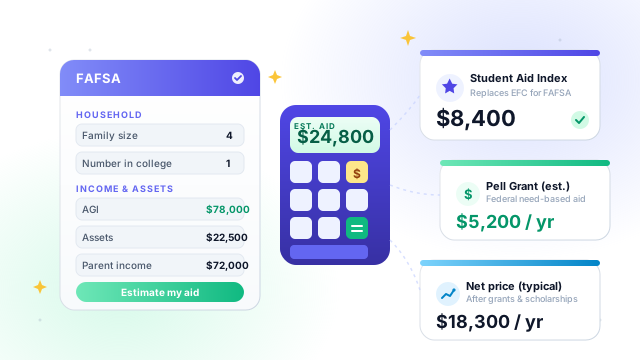
The useful numbers, with the limits made clear.
Every output is designed for early comparison and planning, not as a substitute for a college's official calculator or financial-aid office.
Estimated annual cost
Uses published cost of attendance or the available tuition, housing, books, transportation, and personal-expense components.
Federal and state aid
Shows your estimated federal Pell Grant. State aid is clearly marked as not modeled because rules vary by state and award year.
Merit-aid opportunities
Points you to current college sources without inventing scholarship eligibility or award amounts.
Modeled institutional aid
Provides a broad residual range informed by historical net prices, never an institutional promise.
Net-price range
Compares public historical net-price bands with the college cost estimate for a directional annual range.
Confidence and assumptions
Explains the data coverage, confidence level, fallbacks, exclusions, and every assumption behind the range.
From FAFSA inputs to a college-specific range.
Estimate FAFSA aid
Enter household, income, asset, and residency inputs to estimate SAI/EFC direction and federal Pell eligibility.
Choose a college
Search the public college directory and load its available College Scorecard cost and historical net-price data.
Compare scenarios
Review current inputs, income up or down 20%, and off-campus housing assumptions side by side.
Confirm every estimate with the college.
Current institutional formulas, merit grids, state grants, special circumstances, and available funding are not fully represented in public historical data. High-accuracy results require current rules supplied or licensed by each college.
Federal net price calculator directory